Die Stadt, die es nicht mehr gibt / The city that no longer exists

Few cities have been as thoroughly wiped off the map of modern consciousness as Königsberg. The city might sound vaguely familiar to you: wasn’t some famous philosopher born there? Or, if you’re more mathematically inclined, maybe your first thought is the famously unsolvable problem of the Seven Bridges of Königsberg. Many people, when pressed, recall Königsberg as a place that existed at some point, and might be able to name at least one famous historical figure who was born there. Fewer know what actually became of it.

The seven bridges of Königsberg.

Shortly after I had been to see what was left of Königsberg, a friend of mine posted a joke online about the seven bridges problem. I couldn’t resist commenting that the problem now had a solution, since two of the bridges had been destroyed in the war. I’d just tested it for myself – in Kaliningrad.

In Kaliningrad?

‘Königsberg was taken by the Russians at the end of the war,’ I explained. ‘Then they turned it into Kaliningrad.’

‘Somehow I think I had known that,’ my friend wrote back. ‘But the pieces didn’t click into place until now.’

This wasn’t the only conversation I had like this around the time that I went to Kaliningrad. Even my German friends and coworkers had a similar reaction. Oh, right, Königsberg became Kaliningrad… or I think I knew that, but forgot

It seems strange to me that the world forgot about Königsberg so quickly. It was the capital and largest city of East Prussia, and had been the primary intellectual, cultural, and economic centre of the region for centuries. Before the war, it had a population of nearly 375 000 people, mostly German-speaking, but with significant Lithuanian and Polish minorities.

Königsberg in a 1945 map of Germany. Berlin in the bottom left corner for reference.

Königsberg was famously a city of arts and sciences. The Königliche Albertus-Universität in Königsberg was one of the oldest universities in German-speaking Europe. Its long list of alumni included Immanuel Kant, Simon Dach, and E.T.A. Hoffman, as well as some of the most famous German-speaking mathematicians and natural scientists of the 18th and 19th centuries. The philosopher and political scientist Hannah Arendt was born and raised in Königsberg. Lovis Corinth, Käthe Kollwitz, and countless artists associated with the art colony on the Curonian Spit trained or taught at the Kunstakademie Königsberg, the Königsberg Art Academy.

That Königsberg disappeared entirely in 1945.

The completeness of the break between Königsberg and Kaliningrad is unique among formerly German cities in central and eastern Europe. You can hear it, for example, in the way that people speak. Many people in modern Germany still use the names Danzig and Breslau to refer to Gdańsk or Wrocław. I’ve taken regional German trains to the Czech Republic that still announce the German names of cities and towns in the Sudetenland. But I have never heard a single person in Germany refer to modern Kaliningrad as ‘Königsberg’.

You can see the difference yourself with a short online experiment. Look up any other major, formerly German city like Danzig (GdaÅ„sk/PL), Breslau (WrocÅ‚aw/PL), Memel (KlaipÄ—da/LT) or Reichenberg (Liberec/CZ) on Wikipedia. You’ll be directed to one entry under the city’s current name that describes its development seamlessly from pre-medieval times to the present day, and that result holds whether you’re reading the site in English or German. But the Wikipedia entries on Königsberg stop in 1945.

Before I came to Kaliningrad, I had been warned that there was nothing left of Königsberg to see. Even so: I was shocked at the extent of the city’s physical disappearance.

The urban core of Königsberg centred around a small island in the Pregel river called Kneiphof. Today, this once heavily-populated and heavily built-up island is one large, flat park. Just north of the island, the area that was once the densely-packed Königsberg Altstadt is now a series of parks and empty lots, occasionally interspersed with cheap Soviet-era apartment blocks.

Essentially, the city centre of Königsberg has physically ceased to exist. The new city centre of Kaliningrad lies approximately 2km north of the destroyed centre of Königsberg, around what used to be the Königsberg Nordbahnhof.

There’s something surreal about walking through an empty field and knowing that you’re standing in the very heart of a city that no longer exists. Königsberg back then was larger than the city of Bonn today, and now there’s almost nothing left but dirt, weeds, and cracked concrete.

Within this story of the disappearance of Königsberg, the fate of the Königsberger Schloss (Königsberg Castle) is a particular tragedy. Its distinctive spired tower used to dominate the Königsberg skyline and was a symbol of Königsberg back then just as the TV Tower is a symbol of Berlin today. In the castle cellars, Blutgericht (‘Blood Court’) was the city’s best-known locale, serving up traditional Prussian dishes and drinks like Königsberger Klopse, Ochsenblut, and Bärenfang that are still known in Germany today.

The Königsberger Schloss was also the last known location of the infamous Amber Room (Bernsteinzimmer), which disappeared from Königsberg in the final stages of World War II and has since sparked many conspiracy theories about its possible whereabouts. Rumours have circulated for years that the Amber Room was secretly smuggled back to Germany, or that it was hidden in a Polish bunker, or that it sunk with the ill-fated refugee ship Wilhelm Gustloff when it was torpedoed by the Soviets off the Pomeranian coast in 1945.

The reconstructed Amber Room on display in the Catherine Palace near St Petersburg, Russia.

The scenario supported by most historians, however, is that the Amber Room was most likely destroyed along with the rest of the Königsberger Schloss in April 1945, when the Red Army took the city.

Post-war ruins of the Königsberger Schloss

The Schloss lay in ruins for more than two decades before it was finally demolished on Brezhnev’s orders in 1968. In its place, the Soviets constructed a monstrous government building in Brutalist style which was to be known as the ‘House of the Soviets’. In what some have called the Prussians’ Revenge, however, the extensive network of tunnels under the Königsberger Schloss caused the structure to begin sinking into the ground before the construction could be completed. The new building has never been occupied, and continues to stand on the former grounds of the Königsberger Schloss as a colossal, decaying ‘anti-landmark’ – a fitting symbol for the fate of Königsberg.

The abandoned House of the Soviets, Kaliningrad, on the lot where Königsberg Castle used to stand. Compare with the Königsberg cityscape images above.

And yet, while Königsberg is without a doubt the ‘most disappeared’ city I’ve encountered in my travels around central and eastern Europe, it is also the city that has been the most vividly resurrected in local media.

It always interests me to see how the current occupants of such cities deal with the past. I could go on and on with observations on how the past is handled very differently in GdaÅ„sk vs. in WrocÅ‚aw, or in Poland vs. the Czech Republic or the Baltics. Most, however, tend to downplay the recent German period of their history. While German tourists might refer to the cities with their old German names, you won’t see them displayed much (if at all) in public. You’ll find evidence of that history in museums, obviously, but there’s not a significant effort to ‘bring the past to life’ – understandably so, especially in places where memories of occupation, deportation and violence are still painful.

In Kaliningrad, it’s a different story entirely. The imagery of old Königsberg is everywhere: on signs, on posters, on coffee cups. I was taken aback when I saw more magnets and postcards labelled with ‘Königsberg’ than with ‘Kaliningrad’ in souvenir kiosks. Just thirty minutes away on the Polish side of the border, such a thing would be unthinkable.

(This wasn’t only the case in the city of Kaliningrad, by the way, but applied throughout the region. I have magnets on my refrigerator labelled with the German names of some of the other places I visited in the Kaliningrad oblast: Rauschen [Svetlogorsk], Cranz [Zelenogradsk], Tilsit [Sovetsk].)

It’s tempting to take a cynical or pragmatic view and think, well, that’s just good marketing: Königsberg is easier to sell to tourists than Kaliningrad. But I believe that it’s deeper than that.

There are a couple of examples that stuck out from my time in Kaliningrad which left me thinking that they surely didn’t need to put in that level of effort, and yet they did.

At the Friedland Gate museum, for example, where you can visit a mock-up of a typical Königsberg street, and sit down in a darkened theatre to watch a 30-minute virtual walk through the no-longer-existent streets of central Königsberg, digitally patched together based on a series of rare high-resolution photographs taken in the mid-1930s.

Or at the Bunker Museum, where you can pore over dioramas of the Battle of Königsberg (1945), constructed with an incredible attention to detail that replicate the exact look and feel of the Königsberg cityscape.

After a few days of this deep immersion in the past, the sights and symbols of everyday life in Königsberg started to feel familiar, and nostalgic – like a place I had actually visited once.

I knew the German names of the main streets and knew exactly what they looked like, from the way the stones were arranged in the sidewalks to the patterns in the iron railings of the seven bridges.

I knew what specialties were served on the menu at Blutgericht and could picture its crown-like chandeliers and carved beer caskets clearly in my mind.

I could picture the skyline cut by the Königsberger Schloss. Its presence looming over the city felt just as self-evident to me as that of the TV Tower in Berlin.

I knew that D.O.K. stood for the Deutsche Ostmesse Königsberg. And I knew that its logo was still prominently displayed on the side of a building at Kaliningrad’s Victory Square (formerly: Hansaplatz).

Königsberg began to feel so real and so tangible, it seemed absurd that I couldn’t step out the door and into its streets.

This feeling peaked for me at the Kaliningrad Regional Museum of History and Arts. It’s nothing special, a modest little museum in the former Stadthalle; it doesn’t even translate its displays into English or German. When I went to buy my ticket at the counter, the woman asked if I would like to pay a few more cents to see ‘the panorama’. Why not, I thought.

‘The panorama’ turned out to be a life-size, walk-through diorama spread over two rooms, illustrating three scenes from the Battle of Königsberg: Soviet soldiers crossing the Grüne Brücke (Green Bridge) in front of the Börse (stock market), with the burning silhouette of the Königsberger Schloss in the background; a Nazi barricade in the flooded Blutgericht; and a battle on the quai of Kneiphof island across from the Krämerbrücke (Merchants’ Bridge).

I combed through every corner of this diorama like someone possessed, eager to drink in every possible detail. And oh, what detail. The little bits and pieces of Königsberg that I had been soaking up over the last days all came together here, where they were marvelously brought to life. The streets, the lampposts, the manhole covers, even the patterns in the iron railings of the Krämerbrücke; D.O.M. posters on the walls interspersed with Volkssturm propaganda; the tables, chandeliers, and carved caskets of Blutgericht, with a few cheeky shards of amber in the corner hinting at the fate of the Amber Room. All here, all life-size and carefully replicated for my benefit.

For a long time, I was completely lost to this world of the last moments of Königsberg. There was no one else on that floor of the museum; I had this moment entirely to myself. I spent so long in the diorama that the museum employees eventually came to look for me.

Maybe the fact that the Soviet forces were the ones to capture Berlin and force the Germans to capitulate makes modern Russians feel more secure in embracing their region’s German past than, say, the Poles or the Czechs.

Or maybe Kaliningrad has been able to so enthusiastically embrace its past because the disappearance of Königsberg was so complete. Maybe cities that have more continuity with their past, like Gdańsk or Wrocław, feel a greater need to distance themselves from it. But Kaliningrad has no reason to feel threatened by Königsberg: it has nothing to fear from a ghost.

I left the diorama feeling hungover and disoriented. As if I might step out of the museum and see the towers of the Königsberger Schloss on the horizon. But as real as it felt in that moment, I knew that it wasn’t possible; that it would never be possible. That Königsberg is gone.

Is it possible to feel nostalgic for a place you’ve never been and will never see?

I’ve written before about my love for the Baltic sea, and especially for the unique culture and natural beauty of the Curonian Spit, once just a short train or steamship ride away from the heart of Königsberg. Even before I decided to visit, I’d fallen in love with its writers and artists.

Part of me believes that I would have been happy in Königsberg. I can imagine a nice life for myself there. Studying at the university, strolling along the harbour in the evenings, practicing my Polish in its multicultural streets, spending long weekends on the Baltic coast. The museum curators of Kaliningrad have painted a very vivid picture for me.

I feel a strange kind of melancholy at the thought that as deeply as I immerse myself in the history of Königsberg, these recreations are the closest I’ll ever get. Still, it’s incredible that they exist at all. I’ve never seen such thorough documentation of a lost city and culture.

It reminds me that countries don’t just inherit territory when borders change; they also inherit the history that comes with it. They can tear it down, literally bury the past behind them, or minimise and distort that history for political gain – but it will still be there, lurking under the surface. In Kaliningrad, against all odds, it seems that they’ve made the choice to embrace it.

I found both less and more than what I expected in Kaliningrad. I wasn’t prepared for how little of Königsberg was left. But I was also surprised and deeply touched to see how its past had been painstakingly preserved by its new caretakers. Königsberg, die Stadt, die es nicht mehr gibt, the city that no longer exists – not outside the museums of Kaliningrad, at least.

“…such a city, like Königsberg on the river Pregel, can be taken as a suitable place for the expansion of human knowledge as well as world knowledge, where these, even without travelling, can be gained.” – Immannuel Kant

Künstlerkolonie Nidden / Nida Art Colony

Since my first visit last year, I’ve developed a fascination with the Curonian Spit. The Curonian Spit (German: Kurische Nehrung) is a narrow strip of land separating the Curonian Lagoon from the Baltic Sea, stretching nearly 100km from Kaliningrad in Russia (before 1945: Königsberg) to KlaipÄ—da in Lithuania (before 1923: Memel). These days, the Spit is shared roughly equally between Russia and Lithuania. As with many of the places I visit, however, it once belonged to Germany.

The Curonian Spit has always had a complex history. The ‘indigenous’ population, the Curonians, spoke a Baltic language closer to Latvian than Lithuanian. The Spit has historically been settled by Curonians, Germans, and Lithuanians, and the resulting cultural mix continues to give the Spit its unique character. Even today, the Curonian Spit is largely rural and wild. Most of the Spit is covered in thick pine forests, but its most peculiar feature are its massive sand dunes – the largest in Europe.

In the 1700s and 1800s, widespread deforestation on the Spit led the sand dunes to grow out of control and start swallowing up entire villages – villages that still lay buried under the sand today. The then-Prussian government began a reforestation campaign in the 1800s which succeeded in holding back the so-called ‘wandering dunes’ (Wanderdünen).

Former fishing villages dot the lagoon side of the Spit. These are made up of traditional wooden houses, often with an intricately carved trim that evokes the shape of Baltic waves, adored with a Lithuanian folk carving at the front – often a pair of crossed horse heads. The trim and window sills are traditionally painted in white and ‘Curonian blue’.

A key defining feature or Wahrzeichen of the Curonian Spit are the Curonian weathervanes (Kurenwimpel) that are ubiquitous on the Lithuanian side of the Spit. These decoratively-carved weathervanes used to sit atop the masts of the traditional flat-bottomed fishing boats of the Curonian Lagoon (Kurenkähne) and acted as a visual code to indicate the boat’s home village.

In order to prevent overfishing in the Curonian Lagoon during the 1800s, the Prussian government divided the lagoon into ‘zones’ and decreed that the Kurenkähne could only fish in their local zones. Each boat had to display the symbol of its home village on its weathervane. Over time, fishermen began to add more and more elaborate wood carvings to their weathervanes, turning them into unique works of art.

These days, there are no traditional Kurenkähne sailing on the Curonian Lagoon today, outside one model rebuilt by an artist in the 1990s that gives daily rides to tourists. But the weathervanes remain as an instantly recognisable symbol of regional identity.

Ever since the mid- to late-1880s, artists from East Prussia and even further afield have been drawn to the Curonian Spit for its beautiful, isolated landscapes, its rural charm, and its unique culture at the intersection of Prussian, Lithuanian, and Curonian folk identities. Most came from the nearby Königsberg Art Academy (Kunstakademie Königsberg). Although artists worked and settled all over the Curonian Spit, most came to stay in the largest village, roughly halfway up the Spit: Nida (German: Nidden).

Even on the Curonian Spit, the natural setting around Nida/Nidden is exceptional. The village is located right at the base of the largest range of sand dunes on the Spit, which are visible from its small harbour. Its traditional fishermens’ houses are surrounded by a pine forest that extends to the Baltic coast on the other side of the Spit, only two kilometres away from the main settlement. On a quiet day in town, it’s often difficult to tell whether the gentle rustling you hear is from the wind in the trees or the waves against the shore, or more likely, a harmony of both.

It’s no surprise then that Nidden gradually developed into what was perhaps the most important German art colony after Worpswede.

The artists who passed through or settled down in Nidden over the long span of the art colony’s existence – from about the mid-1800s to 1945 – were not united in a stylistic sense. Dominant movements within the colony did not evolve so differently from trends in the rest of the German art world. While the earliest artists in Nidden tended to paint in the traditional academic style of the Königsberg Art Academy, the colony began to attract impressionist painters starting in the late 1800s. One of its most famous visitors during this period was the East Prussian painter Lovis Corinth, who along with Max Liebermann was among the most important German impressionist painters. One of his best known works, which hangs today in Munich’s Neue Pinakothek, shows the old fishermen’s cemetery in Nidden with a view over the Curonian Lagoon.

The visits of the Brücke artists Max Pechstein (1909, 1911, 1919; 1939) and Karl Schmidt-Rottluff (1913) caused quite a stir within the community. The expressionist style they brought with them from Berlin was trendy, disruptive, and too outrageous for some of the impressionist painters who had settled there earlier. Despite the indignation of some of the older veterans of the colony, who considered the Brücke painters to be too ‘wild’, expressionism became popular among many of the artists in Nidden. Late expressionism would remain one of the dominant styles there until 1945. This would cause problems later on for the art colony and its denizens when expressionism was declared to be entartete Kunst (degenerate art) by the Nazi government in 1937. But this is jumping ahead.

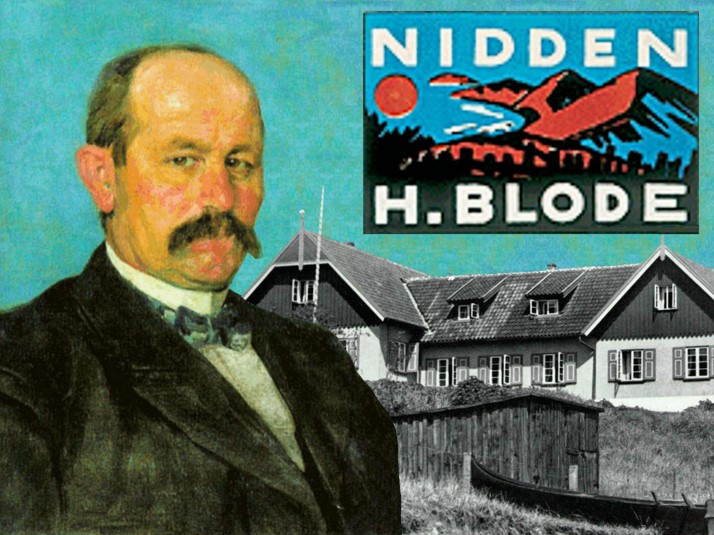
It would be impossible to talk about the Nidden art colony without mentioning the guesthouse of Hermann Blode. It would not be a stretch to say that without Hermann Blode, there would be no Nidden art colony to discuss. Blode’s guesthouse, established in 1867, was the main gathering point as well as the heart and soul of the Nidden art colony. Blode himself was a great fan of the arts and had developed his guesthouse into an artist’s paradise, including studios and exhibition space.

Most famous of all was Blode’s Künstlerveranda – a veranda overlooking the Curonian Lagoon with walls that were covered in paintings by the many artists who had passed through the guesthouse. Guests would gather on the Künstlerveranda to eat, drink, and debate the latest developments in German and European art late into the night. Not only artists, but also writers, scientists, and other leading intellectual and cultural figures like Thomas Mann and Sigmund Freud came over the years to experience Blode’s famous guesthouse for themselves.

Thomas Mann, in fact, was so struck by the landscape and atmosphere of Nidden that he famously had his own summer house built in a traditional Curonian style on top of the hill behind Blode’s guesthouse in 1931.

„Ich freue mich heute schon wieder auf unseren nächstjährigen Aufenthalt in Nidden. Der eigenartige Charakter dieses Landstriches hat nichts Einschmeichelndes, er ist nicht schön im konzilianten Sinne, aber er kann einem ans Herz wachsen, davon kann ich ein Lied singen und habe es heute versucht.“

Thomas Mann, Mein Sommerhaus (1931)

“I’m already looking forward again to next year’s stay in Nidden. The unique character of this strip of land has nothing ingratiating about it, it is not beautiful in a conciliatory sense, but it can grow on one; I could sing its praises and have tried to do so today.”

Thomas Mann, My Summer House (1931)

Unfortunately, Thomas Mann was only able to spend three summers in his Nidden holiday house before he was forced to flee from the Nazis as a political dissident in 1933. His summer house was turned over to Hermann Blode’s successor, Ernst Mollenhauer, for safekeeping. Mollenhauer would use it to accommodate visiting (and fleeing) artists throughout the 1930s. Thomas Mann himself would never return to Nidden. His youngest daughter Elizabeth would be the only one of the household to come back – and then only in 1992.

Ernst Mollenhauer, Hermann Blode’s son-in-law and himself a late expressionist painter, had taken over the guesthouse prior to Blode’s death in 1934. Under Mollenhauer’s direction, the guesthouse expanded its support for the arts. It offered new opportunities for young artists, including the Hermann-Blode-Stipendium, which allowed a selected student from the Königsberg Art Academy to receive room and board as well as studio space for the summer in the Blode guesthouse.

Despite the feeling that one can easily get in Nida/Nidden of being far removed from the rest of the world, events in the ‘outside’ world had existential consequences for this little village on the Curonian Spit.

In 1919, as a consequence of the Paris Peace Treaties, the Memelgebiet (Memel region) – which included Nida/Nidden, the northern half of the Curonian Spit, the city of Memel, and the rural Memel delta area – was cut off from Germany. It was turned into an international zone under the administration of the League of Nations, similar to the Free City of Danzig. The Memelgebiet was then annexed by Lithuania in 1923, turning Nidden (now called Nida) into a Lithuanian border town. Tourism from Germany, including the artists who had previously spent their summers in Blode’s guesthouse, suffered under the new border situation.

Linguistic map of the Memelgebiet from the Museum of the History of Lithuania Minor in Klaipeda. Red areas are German-speaking and green areas are Lithuanian-speaking.

Ten years later, however, as the Nazis took power in Berlin, Nida’s location just a few kilometres north of the German border briefly turned it into a haven for German exiles, dissidents, and other ‘undesirables’ fleeing the Third Reich. A large number of artists active in Nida around that time belonged to expressionist or other ‘degenerate’ modern art movements. As a result, many of the art colony’s core figures, including Ernst Mollenhauer, had received an exhibition ban (Ausstellungsverbot) or a ban on artistic production (Malverbot) in Germany, cutting off access to their largest market. Still, the colony in Nida remained shielded from the worst of the persecutions on German soil – until Hitler re-annexed the Memelgebiet into the German Reich at the outbreak of World War II in 1939.

Even after the reannexation to Germany, however, the art colony was able to hobble along through the early years of the war, and the idyllic village life in Nida continued almost as normal. This is thanks in part – incredibly – to Hitler’s star architect and Minister of Armaments, Albert Speer, who himself briefly stayed in the Blode guesthouse during the war and was able to prevent East Prussia’s Gauleiter Erich Koch from carrying out his plans to turn the village into a KdF (Strength Through Joy) mass holiday resort.

The civilian population of the Curonian Spit was evacuated in late 1944 and the early winter of 1945 as the Red Army closed in on East Prussia. The Nazi government had denied Mollenhauer the permission to transport the Blode guesthouse’s extensive art collection – as well as the work from his own atelier – out of Nida for safekeeping. With the Russians closing in quickly on the Spit, it had to be left behind. The entirety of the guesthouse’s art collection was burned by the Red Army to heat a sauna they had set up in the occupied guesthouse.

Much of the work produced over the roughly 80 years of the Nidden art colony has therefore been lost for good. The guestbook of the Blode guesthouse, which contained detailed records of the artists and other notable guests who stayed over the years in the colony, was also lost in the ensuring chaos. Identifying which artists or writers were active in Nidden, at what time, and who they might have met or influenced there, remains a challenge for German art historians.

The guesthouse of Hermann Blode is still standing – partially. More than half of the complex, including the gutted Künstlerveranda, was torn down by the Soviet government in the 1960s and replaced by a concrete hotel building. The surviving wings of the original guesthouse still house a hotel with cheap prints in the halls of some of the works produced in the Nidden art colony. An entrance in the courtyard leads to a free, one-room exhibition – opened by Mollenhauer’s daughter Maja in the 1990s – on the history of the Hermann Blode guesthouse and the Nidden art colony.

Surviving works produced at the Nidden art colony are scattered across museums and private collections in Germany and beyond. The largest publicly accessible collections exist at the East Prussia Museum in Lüneberg, Germany, and the Pranas Domsaitis Gallery in Klaipeda (Memel), Lithuania. The Kaliningrad Art Museum in Russia has some pieces, and the Brücke Museum in Berlin holds a number of Nidden paintings and woodcuts by Max Pechstein and Karl Schmidt-Rottluff.

In the back of my mind, I’m always looking for Nidden pieces when I visit German art museums. Given that the colony lasted for about 80 years, there are enough works still out there that the search isn’t entirely in vain. Sometimes I stumble across Nidden paintings in unexpected places, and it’s always a thrill. They’re easy to recognise by sight. The Nidden art colony may not have been united in style, but was united in its landscapes and motifs: the wooden houses with blue and white Curonian trims, the sand dunes, the Kurenkähne, and above all, the Curonian weathervanes. You only need to look to the top of the mast to see that the painting comes from Nidden.

People like me who come to modern Nida looking for traces of the Nidden art colony will find only that: traces. The surviving wings of the Blode guesthouse. Thomas Mann’s summerhouse. Hermann Blode’s grave. Nida is no longer a fishing village but a buzzing resort town with bars, restaurants, and a blue flag beach. Every year it gets more popular with foreign tourists who come – at the root of it – for essentially the same reasons that the artists came before: for its natural beauty, its isolation, its relaxed atmosphere and folk charm. Much has changed, but the Nidden you see in paintings is still there underneath the modern resort… if you squint.

Maja Ehlermann-Mollenhauer, the daughter of Ernst Mollenhauer, herself born and raised in Nidden, perhaps expressed it best:

Gravestone of Hermann Blode in the Alter Friedhof, Nida.

„Das alte Nidden gibt es nicht mehr, aber seine Künstlerkolonie lebt in der Kunstgeschichte fort und ist dort wohl am besten aufgehoben. Geblieben sind das Grab Hermann Blodes, das Licht über Haff und Meer, das Rauschen des Kiefernwaldes, das Brausen der See und die Erinnerung in den Herzen der Menschen, denen dieses Land Heimat war.“

Maja Ehlermann-Mollenhauer

“The old Nidden no longer exists, but its art colony lives on in art history and perhaps it’s best preserved there. What remains are the grave of Hermann Blode, the light over lagoon and sea, the rustling of the pine forest, the crashing of the waves, and the memory in the hearts of those for whom this was their homeland.”

Maja Ehlermann-Mollenhauer

Sources:

Tilsit / Sovetsk

“Nun standen die Russen an der Grenze, die Sirenen heulten jeden Tag, und durch die Siedlung schrillten die Todesschreie von Schweinen. Alles Vieh schlachten und das Hab und Gut schon mal probeweise aufpacken, obwohl’s streng verboten war, an Flucht zu denken. … Die Volksgenossen, die im Herbst aus dem Osten gekommen waren, aus Tilsit, aus Litauen und Lettland, konnte man nicht fragen, ob sie Vertrauen zur deutschen Wehrmacht hätten. Da hätte man die richtige Antwort bekommen oder gar keine.”

“Now the Russians were at the border, the sirens howled every day, and the settlement rang with the shrieking of pigs. Slaughter all the livestock, start packing up possessions, although it was strictly forbidden to think of fleeing. … The fellow Germans who had come in that autumn from the east, from Tilsit, from Lithuania and Latvia, couldn’t be asked whether they had faith in the German Wehrmacht. One would get the right answer, or none at all.”

Alles umsonst (“All for Nothing”), Walter Kempowski

The first I’d ever heard of a place called Tilsit was in Alles umsonst, Walter Kempowski’s haunting final novel, which follows the fate of an aristocratic German family in the East Prussian countryside as the Red Army closes in during the winter of 1945. The story takes place near the fictional town of Mitkau, somewhere between the real-life cities of Elbing (ElblÄ…g) and Allenstein (Olsztyn). As the story starts, there is little communication from the outside world; the horizon glows at night from fires in the distance; rumors that the Russians are close circulate through the town, and yet no one seems to know how close. Life continues as usual on the surface, but underneath, the residents have the creeping feeling that perhaps they should start making preparations to leave – just in case.

Although Tilsit is only mentioned a few times, it becomes an ominous sign of what awaits the rest of German East Prussia. Already at the start of the novel, evacuees from Tilsit are being housed in the local school; a slow but not yet alarming trickle of families in wagons pass through town without stopping, fixated on pressing further west. It’s implied but rarely spoken out loud that things in the east – in Tilsit – have taken a dark turn, and the locals in town are growing more anxious every day.

Tilsit is – or was – a real place, a small East Prussian city located just across the Neman (Memel) river from Soviet Lithuania in the USSR. It thrived in its status as a border town: although majority German, it had a large ethnically Lithuanian minority and was an important centre of Lithuanian language publishing outside the reach of the censors in Russian-controlled Lithuania. The famous Queen Louise Bridge (Königin-Luise-Brücke) over the Memel river, built in honour of the 100th anniversary of the Napoleon-era Treaties of Tilsit, was – and still is – the most recognisable symbol of the city.

The bridge was blown up by the Germans in October 1944 to stall the advance of the Red Army. Nevertheless, as an important border town, Tilsit was one of the first German cities to be taken by the Red Army in the East Prussian Offensive of January 1945. After the war, it was annexed by the Soviet Union and incorporated into Russia’s Kaliningrad oblast, along with Königsberg and the northern part of East Prussia. As was the case all over the region, any surviving Germans were expelled west, and the city was repopulated – mostly by ethnic Russians. In 1946 it was renamed Sovetsk.

But who even remembers Tilsit these days?

That was the title of an article from 2007 in Die Welt, one of the first and only modern German articles on the city that came up when I searched for the city out of interest after coming across it in Alles umsonst. The author writes: ‘What lay on the other side of the Oder and was German until the Second World War has been blocked out, suppressed, forgotten.’

In Germany, that may be true. Curiously though, it doesn’t appear to be true these days in ‘Tilsit’ itself.

I came to Sovetsk in June 2019 as part of a larger trip around the Kaliningrad oblast. I wanted to experience it for myself, to see and feel what history there was to be seen and felt. It wasn’t mentioned in my guidebook and there’s not much more information to be found online (in English or German at least), so I wasn’t sure what to expect.

Sovetsk greets its visitors right away with an assertion of its Russian-ness on the plaza in front of the train and bus station. The First Settlers Monument commemorates the Soviet citizens (mostly ethnic Russians) who arrived in 1945 to repopulate the region as a Soviet territory.

And yet, just five minutes away at the start of the main street through the old city centre is a sort of parallel monument – a streetcar from the old Tilsit. On one side, the windows are plastered with images from modern Sovetsk – public notices, photos from community events and local sports teams. On the other side, the windows are filled with old photos of Tilsit.

Old photos of Tilsit are in fact common throughout the city centre of Sovetsk. Postcards and other souvenirs are just as likely to say Tilsit as Sovetsk. If you have ever traveled through formerly-German cities on the other side of the border in Poland, where the German history of the area is acknowledged but largely kept under the surface, the openness with which Sovetsk shows off its German history is a bit stunning.

Even more stunning, perhaps, if you consider that Tilsit has largely been forgotten by Germans themselves. (‘As far as I was concerned, Tilsit could have been on the Mississippi or on Mars,’ as the author cited in the above Welt article recalls.) While there are ‘Heimat’ tours that take groups of German tourists around to major sites in the former East Prussia, including Tilsit, the clientele are usually limited to older generations with ancestral roots in the area. When I mentioned to German friends and coworkers that I was going to visit Tilsit, none knew what or where it was, and one responded, ‘Tilsit like the cheese? I didn’t realise that was a real place.’

Having so many visible representations of old Tilsit around modern Sovetsk makes it impossible to avoid comparing the past with the present. And unfortunately, the conclusion is often that the city has seen far better days. This is nowhere more clear than at the waterfront, which has decayed almost beyond recognition.

As in other smaller cities of the Kaliningrad region, the city centre itself is full of pre-war buildings. Some have been well-maintained or renovated, but most appear to be in some state of disrepair.

As a side note, it’s remarkable how easy it is to identify the German buildings – especially when you come to Sovetsk from the thoroughly-rebuilt city of Kaliningrad, or from any other part of Russia, where the contrast is striking. The architectural style of the pre-war buildings in Sovetsk is very similar to the kinds of buildings you see in northeastern Germany today, e.g. in Brandenburg or Mecklenburg-West Pomerania.

What I love about places like Sovetsk – about the Kaliningrad region as a whole, in fact – is that its history is seeping out of every pore. The previous residents are gone and the city has been thoroughly Russified: streets renamed, facades painted over, stone reliefs chiseled away, monuments replaced, large parts of town torn down or rebuilt. But the history of the city is still there, lurking just beneath the surface.

In some places, you can literally see the past peeking through into the present. Like this building facade, which has crumbled away to reveal the original German text underneath: ‘Lebensmittel’, a grocery store.

I feel sometimes like I shouldn’t be as excited by this as I really am. After all, there’s a reason that postwar Germany chose to forget about places like Tilsit. There’s no point in chasing that past any longer, because it belongs to a part of history that is over now and not coming back. In a certain light, the near-complete lack of memory of Tilsit in Germany today speaks to an impressive ability to let go of the past and focus on moving forward.

But letting go of the past should never be the same as forgetting it. There’s something both unnerving and comforting in the way that the past persists through the present in a place like Sovetsk; in the way that a city’s history is still there even if you change its name and exchange its entire population. Unnerving because it means that it’s impossible to erase the past and start over with a clean slate. Comforting for exactly the same reason: That the past is always going to be there in some form or another to seek out and learn from. No one has the power to erase its presence entirely.

Berliner Straßenszenen / Berlin Street Scenes

Some of the best moments as an amateur art-lover are the ones when you first see a new piece, a new artist, or a new movement, and think: ‘Yes, this.’

EL Kirchner, Berliner Straßenszene (Berlin Street Scene; 1913)

That was me back in 2012, when I first saw an exhibition on the German expressionist group Die Brücke (1905-13) at – of all places – the Musée de Grenoble. It was about eight months after I’d first come to Europe, and I had yet to realise that I liked art. Although I went straight for the art museums in every city I visited, I hadn’t made the connection yet that this was something I could like. Being ‘into modern art’ felt like something that was for rich, cultured people… not for someone like me.

Still, the expressionist style left a deep impression on me back then. At the time, I was just starting to come out of a long episode of depression. The anxious contours and otherworldly colour schemes of the Brücke artists, but especially of Ernst Ludwig Kirchner, really spoke to my mental state at the time. I felt like I had finally found a branch of modern art that I could emotionally relate to.

Die Brücke mostly fell off my radar for the next few years, until my interest was piqued again in 2016 by a solo exhibition of Kirchner’s work at the Hamburger Bahnhof in Berlin. This exhibition was where I first encountered – or recall encountering – Kirchner’s Berliner Straßenszenen (Berlin Street Scenes), starting with Potsdamer Platz (1913), pictured below.

EL Kirchner, Potsdamer Platz (1913)

The Straßenszenen are a set of sketches and paintings produced by Kirchner between 1913 and 1915, i.e. during the period right after the Brücke collective officially dissolved itself in May 1913 due to infighting among its members (chiefly between Kirchner and the others – but that, again, is another story).

The Brücke collective was founded in Dresden but relocated to Berlin in 1911, a move that highlighted and exacerbated significant creative differences within the group. At the time, Berlin was developing at an incredible pace. It was experiencing all the typical problems of a metropolis that was growing too quickly for its own good: urban poverty, prostitution, and an infrastructure straining to accommodate all the newcomers.

As a result, the move to Berlin had a highly polarising effect on the Brücke artists; the group had been heavily inspired early on by primitivist and ethnographic art, after all. Some, such as Karl Schmidt-Rottluff, felt out of their element in the racing pulse of the capital and preferred to retreat to the countryside.

EL Kirchner, Fünf Frauen auf der Straße (Five Women on the Street; 1913)

Kirchner, on the other hand, felt both energised and alienated by the relentlessly urban environment of the Großstadt. In channeling those feelings into his art, into the Straßenszenen, he produced not only some of the most notable works of his career but also some of the most famous modern representations of urban anxiety.

Kirchner’s Straßenszenen, beginning with Fünf Frauen auf der Straße (Five Women on the Street; 1913), portray scenes of urban street life at the turn of the century. The visual style is highly distinctive. Short, nervous brush strokes and an occasionally ‘sickly’ colour scheme convey a uniquely modern sense of anxiety.

The figures that populate the world of the Straßenszenen, largely prostitutes and their clients, are front and centre, sometimes shoved uncomfortably close to the viewer. Their shapes are angular and elongated, skin discoloured, and faces often abstracted to just eyes and cheekbones, making the figures of the Straßenszenen appear as otherworldly creatures of the night. Although they are the subjects of the piece, there is no emotional connection between them and the viewer. The figures appear to either ignore you completely or stare uncomfortably in your direction.

Even though they were created more than a hundred years ago, the Straßenszenen manage to tap into a very particular feeling of urban alienation that is still recognisable today: the feeling of being hopelessly alone in a fast-moving city packed with strangers. A feeling that perhaps anyone who has moved to a new city can understand.

Kirchner himself wrote that the Straßenszenen emerged during ‘one of the loneliest times of my life, when an agonising restlessness drove me out day and night, again and again, into long streets full of people and carriages’. It’s a restlessness that I know well from the loneliest times in my life, too, when I felt compelled to go nowhere in particular to do nothing other than be somewhere else. When you’re lonely, it can feel comforting to just be out among other people – even the otherworldly strangers of the Berlin streets.

It’s oddly soothing to see your own internal struggles reflected in paintings from a hundred years ago. It’s a nice reminder that you’re not alone, that your struggles are normal human struggles, that others have felt how you feel now. In my opinion, it’s one of the best reasons to engage with art and literature.

Swinemünde / Świnoujście

I have a comforting relationship with the Baltic Sea. It’s far enough away from Berlin – about three hours by train to the nearest coastline – that it isn’t practical to go all the time, meaning that when I do make the trip out, it still feels like a treat. But it’s also close enough that after a particularly frustrating week, or any time when I suddenly feel that I have to leave town, the Baltic is a convenient place to flee to.

A bit more than two years ago, I discovered the perfect little Örtchen which has since become my go-to destination for whatever ails me: ÅšwinoujÅ›cie. Or, as it was known in a previous life: Swinemünde.

As the name change might suggest, Świnoujście (shwee-noh-oosh-chya) once belonged to Germany, but is now located in modern-day Poland. It makes up the eastern tip of the island Usedom (Polish: Uznam), which has been shared between Germany and Poland pursuant to the Potsdam Agreement since the end of WWII.

There are two ways to access ÅšwinoujÅ›cie, both taking about 4-5 hours from Berlin. The town is well-connected by road and rail to the German side of the island: the miniature rail Usedomer Bäderbahn (UBB) links ÅšwinoujÅ›cie to the German resort towns of Heringsdorf and Ahlbeck and runs westward to Züssow on the German mainland, with some trains continuing as far as Greifswald and Stralsund.

swin-ferry
The ferry to Swinoujscie from the Polish mainland

There are no land connections at all between the town and the Polish mainland; it is essentially the Point Roberts of Poland. The only way to reach Świnoujście from the Polish side is with a (free) passenger ferry from the train station on the opposite coast. Without a car, the only train connection to this far-flung corner of Poland is through the industrial port city of Szczecin. This was how I came to Świnoujście for the first time.

IMG_20170729_163332800
Map of Swinoujscie

Świnoujście is laid out like a typical Baltic resort town. The area around the ferry terminal makes up the downtown, with restaurants, retail outlets, and a shopping mall. Small streets lead from the downtown core through leafy parks to a resort area filled with old villas and holiday apartments, the entire length of which is spanned by a promenade that continues west for several kilometres into Germany. The promenade is intersected regularly by paths that lead through a narrow strip of forest, over a hill, and out to the beach.

As with most significant ports on the Baltic, much of Świnoujście/Swinemünde was heavily damaged through bombing campaigns near the end of WWII. Enough of the old Prussian-style villas remain to make parts of town look and feel similar to the resorts just over the border in Germany. Nevertheless, some Communist-era reconstructions in the downtown and around the resort area lend other parts of town a cheap or tacky feel.

I first came to ÅšwinoujÅ›cie on a day trip from Szczecin, and was… entranced. I returned soon after to spend the weekend of my 26th birthday there, in order to see and understand more about this place.

It is always a pleasure to come to the coast. After long periods spent inland among the dreary concrete of Berlin – as much as I love it there – just seeing the sea again, having the chance to walk along the coast, feel the wind off the water, and listen to crashing of the waves, is deeply refreshing.

IMG_20171202_102547325

There’s also something about the Baltic Sea in particular that reminds me of where I grew up on the west coast of Canada. I think it’s the overcast skies, the changeable weather and the relative chill. Somehow the Mediterranean has just never managed to do it for me like the Baltic does. ‘The coast’ in my mind is something grey, cold and stormy – not blue, warm and placid. I love to bundle up and visit the Baltic in the off-season while the crowds are gone.

20181202_145930

IMG_20171202_103235776I’ve gone now twice in a row to ÅšwinoujÅ›cie on my birthday in early December and enjoyed it both times. It’s a lovely thing to get up in the morning and walk along a moody coastline from Poland to Germany and back. Every year, the Baltic swans are out on the beach to greet me; rain or snow, they’re somehow always there, waiting for company.

To tell the truth, although I have come back a number of times over the years, I have never been to ÅšwinoujÅ›cie in the summer high season. I’m not sure that I ever want to, out of fear that I might be too put off by it to ever return. The fact is, ÅšwinoujÅ›cie is several times cheaper in every aspect than any of the neighbouring resorts in Germany, and the resorts are in many ways interchangeable: they share the same beach, after all. There are no border controls, and euro is accepted in ÅšwinoujÅ›cie almost as easily as Polish zÅ‚oty. So Germans flock to ÅšwinoujÅ›cie in the thousands to take advantage of the cheap prices, with the result that German is just as commonly heard on the streets as Polish, and parts of town pander shamelessly to German tourists, even in the off-season.

The overwhelming German presence in ÅšwinoujÅ›cie has its good and bad sides. In some ways, the border region of ÅšwinoujÅ›cie-Ahlbeck-Heringsdorf is a model of European integration: the two countries share a beach and resort promenade, public transport and tourist trains run between resorts across the border, and a common bike sharing system means that you can pick up a city bicycle in Poland and leave it in Germany. But the focus on integration masks the reality that this relationship is anything but equal. You can see it in the little things, like the fact that prices in ÅšwinoujÅ›cie are often quoted in euro, but prices in Ahlbeck and Heringsdorf are never given in zÅ‚oty, as well as in the larger things – like the fact that seemingly most Poles in ÅšwinoujÅ›cie can speak at least basic German, while the German visitors hardly bother with Polish.

IMG_20170729_130343268_2
“Cheap Cigarettes”

By far, the most uncomfortable expression of this dynamic that I personally witnessed was in the Grenzmarkt. The Grenzmarkt (‘border market’) is a semi-permanent flea market along the main street that leads to the German side of the island. It stretches out over more than a kilometre and appears to be constructed mostly from individual wooden booths pushed together and covered by rusting sheet metal and plastic tarps. The Grenzmarkt is the hub for Germans seeking any variety of low-quality goods at rock-bottom prices: cartons of cigarettes, off-brand alcohol, pirated DVDs, knock-off track pants. Polish sellers hock their wares in varying degrees of broken German (schöne Dame, wollen Zigaretten?) while the German visitors stroll by, unimpressed. The overall impression is grotesque: on one occasion I saw an elderly German woman snap her fingers at a Polish saleswoman, announcing, ‘I’m ready to be served now.’ It looks and feels more like a scene out of a third-world country, or at least a place that should be much further east than here.

For me, though, being in ÅšwinoujÅ›cie as a non-German visitor had a peculiar draw. This isolated, far out-of-the-way corner of Poland is not accustomed to having foreign visitors from outside Germany; by virtue of being there and not being Polish, I was therefore presumed to be ‘one of the Germans’. Whenever I attempted to speak with someone in my limited Polish or in English, they would instantly switch to German with me. Coming from Berlin, where exactly the opposite situation was an everyday frustration, this experience was surreal to say the least.

To be honest, I enjoyed it.

IMG_20171202_102401281
Pathway to the beach

In Berlin, my accent and occasional mistakes mark me everywhere as ‘not German’. My foreignness in Germany isn’t something I can hide; it’s plain to every person I meet. And after spending years settling into this country, building a life for myself here, it gets tiring to be constantly asked by strangers where I’m from and how long I’m staying. So in all truthfulness, it was fun, somehow, to come to ÅšwinoujÅ›cie and be presumed to be ‘just another one of those Germans’ by people who can’t as easily identify my accent or catch my mistakes. The irony is not lost on me that it was in Poland, of all places, where I most felt like I ‘belonged’ in Germany.

The side effect of being ‘presumed German’, however, was that it drew me into this complicated German-Polish dynamic, whether I wanted it or not.

It’s only in hindsight that I realise how often, as a traveller, I have relied on the privilege of belonging to a relatively ‘neutral’ nationality. Few people abroad have strong opinions about Canadians, and this works to my benefit. Not once have I ever worried about how someone might react if I tell them where I’m from. There aren’t many harmful stereotypes out there for me to counter, and I would never expect someone to force me to answer for elements of my country’s history or foreign policy. It’s not that we’re so innocent, it’s just that hardly anyone outside Canada knows or cares.

Not so in ÅšwinoujÅ›cie. It’s not that people there have treated me badly when they think I’m German. It’s just that I can sometimes tell that my presence there isn’t as neutral as I’m used to. I do think that this awareness started at the Grenzmarkt, where I was shocked by some of the interactions I witnessed. After that, I started seeing the dynamic more and more for what it was, and I started realising that I was being pulled into it too.

20181202_172057
Night in the resort area of Swinoujscie

I believe it was my fault for getting too comfortable with the widespread understanding of German in ÅšwinoujÅ›cie, or being too pleased with myself for playing the role of the German tourist. At some point I dropped the broken Polish and started just speaking to people there in German like the ‘other’ tourists, reasoning that it seemed clear most of the locals understood it better than English anyway. In retrospect this was inconsiderate.

It’s just little things. The last time I was in ÅšwinoujÅ›cie, I entered a popular restaurant and asked the server if she spoke English or German. She sighed in clear exasperation and muttered something under her breath, before answering ‘Ja, Deutsch’ in an annoyed tone. And just like that I felt uncomfortable, unsure what to say. My Polish is very basic; she doesn’t speak English; on a practical level, German is the only language we have in common. This is par for the course in ÅšwinoujÅ›cie. But embracing it identifies me, from the locals’ perspective, as ‘one of those Germans’ – and some of the locals clearly have strong feelings about those Germans. Stronger feelings than I’m used to being on the receiving end of when I travel. And I’m not sure anymore how to react.

I still come to ÅšwinoujÅ›cie. Of course I do. I can’t resist a cold day on the Baltic sea, let alone one in a hidden-away corner of Poland with such a complex borderland dynamic – and all that within a few hours of Berlin.

But coming here remains a strange experience. One where I can’t just sit and watch it all unfold like a ‘neutral’ foreigner, the way I’m used to – the way I like it. When I come to ÅšwinoujÅ›cie, people see me as being ‘from Germany’ with all that that implies, good and bad. And to this day, I have mixed feelings about that.

img_20171202_102845500-1.jpg

Berlin ist kein Sehnsuchtsort / Berlin is no Sehnsuchtsort

Berlin is an ugly city.

The most passionate bloggers in this city wouldn’t claim otherwise. Except, perhaps, the Berlin Typography guy. But even so, the strangely pleasing aesthetics of Berlin typography are not ‘beautiful’ in the same way that Parisian storefronts are beautiful, or Tuscan villages are beautiful. Berlin just doesn’t have that charm.

Berliners have no illusions about this. The ugliness of our streets has been elevated beyond the point of a running joke; it’s a statement of fact, mentioned in passing by Berliners in conversation in the same way that you would state any mutually-agreed fact that you wouldn’t seriously expect another person to contradict. 

Take Berliner musician Peter Fox’s popular ode to the city, Schwarz zu Blau (Black to Blue), a song and music video about stumbling home at dawn through the streets of Berlin-Kreuzberg, populated with unfriendly characters, vomit, and buses that never arrive. Without a hint of irony, the chorus goes like this:

Guten Morgen Berlin
Du kannst so hässlich sein
So dreckig und grau
Du kannst so schön schrecklich sein…

Good morning Berlin
You can be so ugly
So dirty and grey
You can be so wonderfully dreadful…  

An ode to an ugly city if there ever was one.

An interesting point about the aesthetic quality of this city is that it has been both much better, and much worse. Berlin newspapers like the Morgenpost and the Tagesspiegel delight in posting regular features on Berlin ‘damals und heute’ (then and now), ranging from the imperial glory of pre-WWII Berlin to the smouldering ruins of the city centre in 1945 and bleak scenes of war-damaged neighbourhoods divided by the Berlin Wall. In comparison to the latter two, the bland concrete we live in today is a real improvement.

Sometimes, when the concrete looks particularly grey and depressing, it’s hard not to long for a Berlin that doesn’t exist anymore. A Berlin where the area around Hallesches Tor and Belle-Alliance-Platz (now: Mehringplatz) looked like this:

Instead of like this:

But even though the older pictures hold a certain classical European charm when seen through modern eyes, Berlin was not considered particularly beautiful by contemporaries in the pre-war era either. It was rapidly and chaotically developed from a ‘swampy backwater’ to a modern industrial city largely after the unification of the German Empire in 1871 – relatively late compared to other major European capitals like London and Paris. The title of a recent book on the history of Berlin sums up the city’s eternal status as an underperformer in aesthetics: ‘An der Schönheit kann’s nicht liegen’ (‘It can’t be the beauty’).

And indeed, it has never been the beauty of Berlin that has been its primary appeal. Berlin has been many things to many people over the years. A refuge for the French Huguenots during the 16th century. The original sin city of the Weimar era. Capital of Nazi Germany. Symbol of the Iron Curtain, symbol of hope. What it has always been is profoundly interesting. Behind every grim postwar facade is a hidden story about what used to be there and why it’s not there anymore.

Few places in the world are as laden with 20th century history as Berlin, and the city’s modern ugliness is a testament to the forces of that history. Having the will and the interest to look beyond the surface is richly rewarded here. Berlin is a place where you can discover for the first time, after three years, that an unassuming S-Bahn station you pass every day used to look like this.

Or that a big chunk of concrete in the garden colony down the street from your apartment was built by Hitler’s architect Albert Speer as part of abandoned plans to radically reshape Berlin into ‘Welthauptstadt Germania’ (World Capital Germania).

Or that everywhere you go, even the ground beneath your feet tells the story of the people who used to be there – but aren’t there anymore.

As with everything, the Germans have a word for ‘a place you long to be’: der Sehnsuchtsort. The meaning is deeper than simply ‘a place you’d like to go’; Sehnsucht is not a mere want, but a longing or yearning for something. Italy is the traditional Sehnsuchtsort of German art and literature, popularised by Goethe before being taken up in earnest by German Romantic painters.

In this sense, Berlin is no Sehnsuchtsort. Its cityscape is not the kind that inspires classical poets. Musicians don’t sing about the beauty of Berlin in the way they have sung about the beauty of Paris or Rome, and surely they never will. In the streets of Paris, French impressionists once painted bright, airy depictions of modern life; in the streets of Berlin, German expressionists painted erratic scenes of urban anxiety.

Berlin isn’t as instantly lovable as the older and less damaged capitals of Europe. Berlin is complicated. It begs you to give it a closer look. Berlin is like the compelling anti-hero in a well-written novel, inviting you to peek beneath its rough exterior, to dig deeper into its complex past, until you realise, ‘Aha, so that’s why you are the way you are.’ Each new chapter and each re-reading of the text tell you something new that you didn’t see before and bring you slightly closer to understanding the bigger picture.

The appeal of Berlin isn’t on display for the world to see. It has to be uncovered, day by day. Bits of history are all around in this city, hiding in plain sight and just waiting for you to find them. If you, like me, have an inclination towards history and an urge to go out and discover it, there’s no place more rewarding than ugly Berlin.